> ## Documentation Index
> Fetch the complete documentation index at: https://docs.getmodus.com/llms.txt
> Use this file to discover all available pages before exploring further.
# Home
> The Modus Home page — chat across your whole environment, tag scopes for specialist help, choose a model, and run workflows inline.
**Home** is where you get work done in Modus. It's a chat surface that talks to
your entire environment — your [connections](/guides/connect-apps), tools, and
[context](/guides/context) — so you can ask questions and run things in plain
language, and watch Modus use real tools to answer.
 ## Chatting with Modus
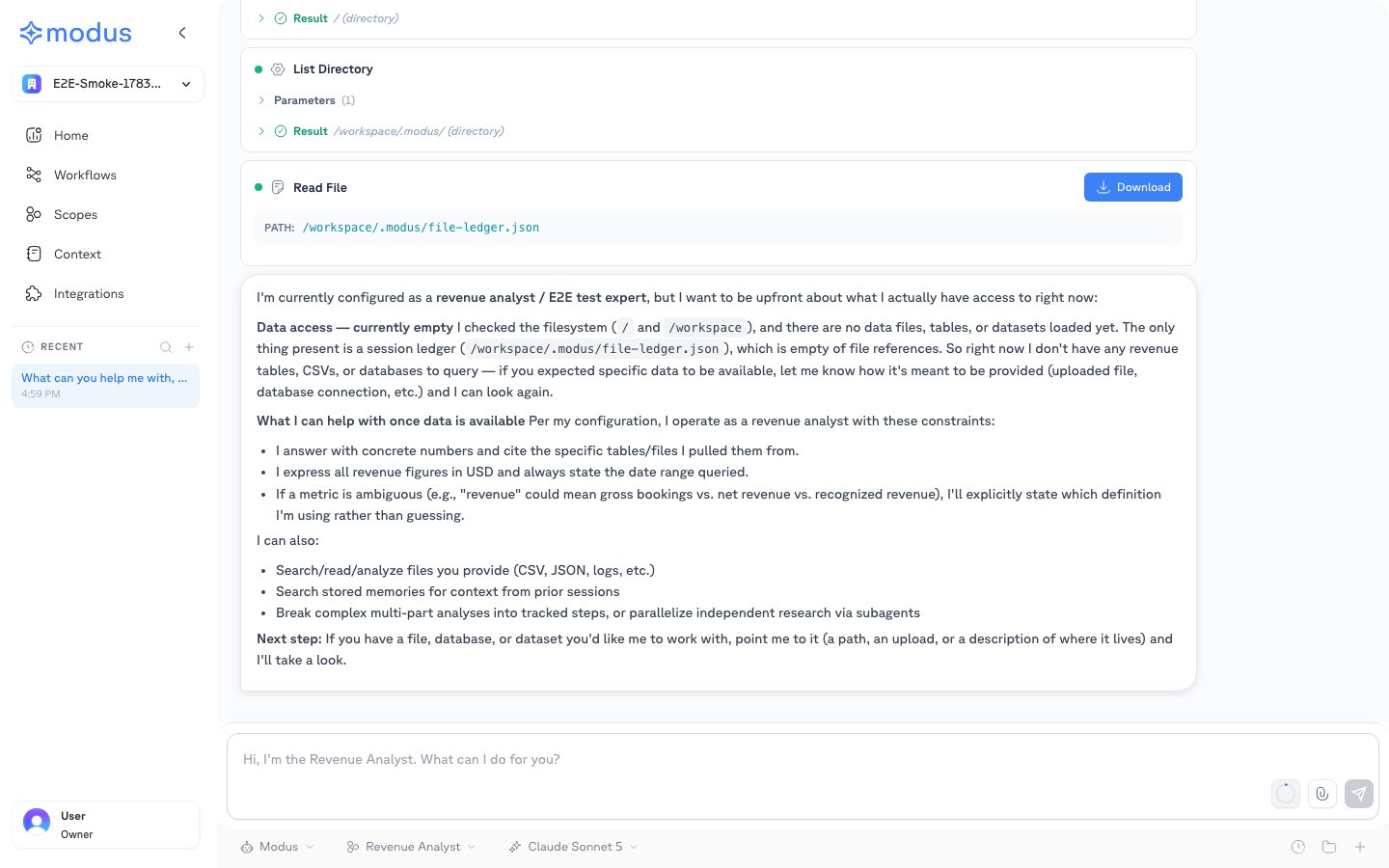
Type a message and Modus answers using the context it has built from your
integrations. By default you're talking to **Modus**, the general assistant that
spans your whole environment. Modus doesn't just reply from memory — it can
**read your files, query your connected data, and search stored knowledge**,
showing each step (like the *List Directory* and *Read File* steps above) so you
can see exactly how it reached an answer.
Every conversation gets its own workspace: files a scope creates or edits during
a chat live in that conversation's **filesystem**, and useful facts can be saved
to **memory** for next time.
## The controls below the message box
## Chatting with Modus
Type a message and Modus answers using the context it has built from your
integrations. By default you're talking to **Modus**, the general assistant that
spans your whole environment. Modus doesn't just reply from memory — it can
**read your files, query your connected data, and search stored knowledge**,
showing each step (like the *List Directory* and *Read File* steps above) so you
can see exactly how it reached an answer.
Every conversation gets its own workspace: files a scope creates or edits during
a chat live in that conversation's **filesystem**, and useful facts can be saved
to **memory** for next time.
## The controls below the message box
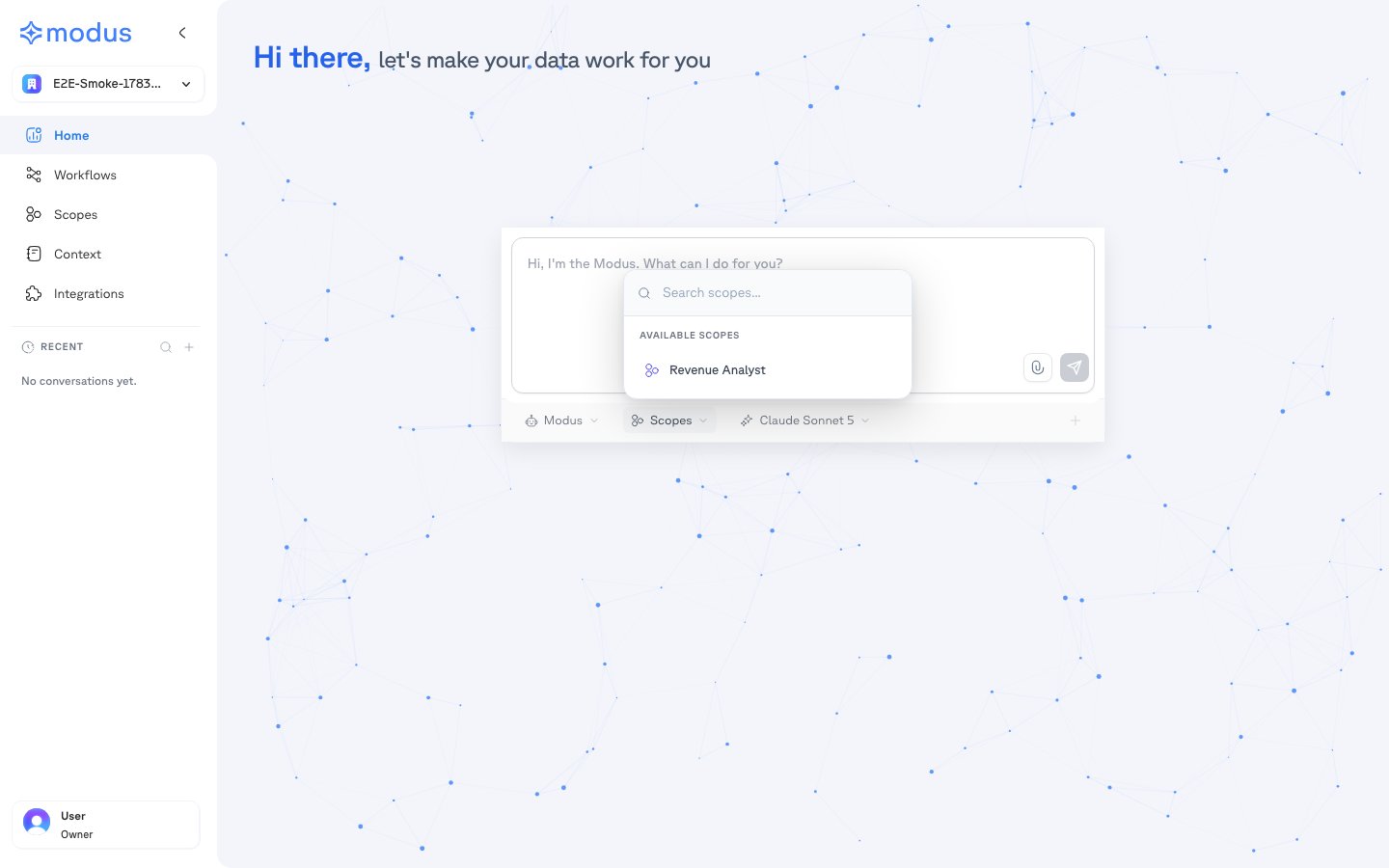 * **Assistant / workflow selector** — start from the default **Modus** assistant, or pick a conversation-triggered [workflow](/guides/workflows) to run it right in the chat.
* **Scopes** — tag one or more [scopes](/guides/scopes) to bring in a specialist's instructions and focused context (shown above). Search and select the experts you want; the conversation then answers with their expertise and their slice of your data.
* **Model selector** — choose which AI model powers the response, grouped by **Most Capable**, **Balanced**, **Fastest**, and **Most Affordable** so you can trade off quality, speed, and cost per task.
* **Attachments** — attach a file to the message to have Modus analyze it directly.
## Tagging scopes for specialist help
A [scope](/guides/scopes) is a specialist AI configured for a specific domain,
with its own instructions and a focused slice of context. Open the **Scopes**
dropdown, search, and select the specialists you want — the chat then answers
with their expertise instead of the general assistant. Tag more than one to
combine specialists in a single conversation.
## Running workflows inline
Pick a conversation-triggered [workflow](/guides/workflows) from the assistant
selector to run a multi-step pipeline from the chat. Modus renders each step —
AI steps, conditions, actions, and human-approval gates — **inline as it runs**,
so you can follow the pipeline and step in when a run needs your approval.
## Managing conversations
Your chats are saved. Near the message box you'll find:
* **Conversation history** — reopen a recent conversation. Recent chats also appear in the sidebar.
* **Conversation filesystem** — browse the folders and files a scope created or modified during the chat, and download them.
* **New conversation** — start a fresh thread.
New to Modus? Connect a [data source](/guides/postgresql) or [app](/guides/connect-apps)
first so Modus has context to work with, tag the relevant [scope](/guides/scopes),
then ask your question here.
* **Assistant / workflow selector** — start from the default **Modus** assistant, or pick a conversation-triggered [workflow](/guides/workflows) to run it right in the chat.
* **Scopes** — tag one or more [scopes](/guides/scopes) to bring in a specialist's instructions and focused context (shown above). Search and select the experts you want; the conversation then answers with their expertise and their slice of your data.
* **Model selector** — choose which AI model powers the response, grouped by **Most Capable**, **Balanced**, **Fastest**, and **Most Affordable** so you can trade off quality, speed, and cost per task.
* **Attachments** — attach a file to the message to have Modus analyze it directly.
## Tagging scopes for specialist help
A [scope](/guides/scopes) is a specialist AI configured for a specific domain,
with its own instructions and a focused slice of context. Open the **Scopes**
dropdown, search, and select the specialists you want — the chat then answers
with their expertise instead of the general assistant. Tag more than one to
combine specialists in a single conversation.
## Running workflows inline
Pick a conversation-triggered [workflow](/guides/workflows) from the assistant
selector to run a multi-step pipeline from the chat. Modus renders each step —
AI steps, conditions, actions, and human-approval gates — **inline as it runs**,
so you can follow the pipeline and step in when a run needs your approval.
## Managing conversations
Your chats are saved. Near the message box you'll find:
* **Conversation history** — reopen a recent conversation. Recent chats also appear in the sidebar.
* **Conversation filesystem** — browse the folders and files a scope created or modified during the chat, and download them.
* **New conversation** — start a fresh thread.
New to Modus? Connect a [data source](/guides/postgresql) or [app](/guides/connect-apps)
first so Modus has context to work with, tag the relevant [scope](/guides/scopes),
then ask your question here.