> ## Documentation Index
> Fetch the complete documentation index at: https://docs.getmodus.com/llms.txt
> Use this file to discover all available pages before exploring further.
# Context
> The Modus Context page — your organization's knowledge base of context items that make AI answers accurate, with statistics, filtering, and verification.
**Context** is your organization's context layer — the facts, definitions, and
relationships Modus draws on to answer accurately. Modus builds it automatically
from your [integrations](/guides/connect-apps) (a process called *mining*) and
keeps it fresh as your data changes — **without moving or copying your data**; it
maps where things live and fetches through your connectors on demand. Everything
your [scopes](/guides/scopes) and [Home](/guides/home) chats know comes from here,
and you can add to it yourself.
 ## Context Statistics
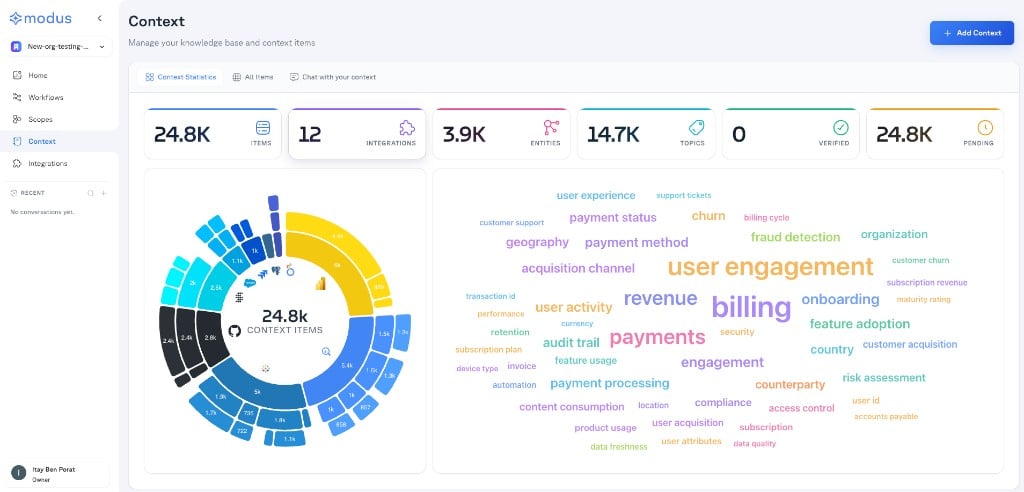
The default view is an at-a-glance dashboard of your knowledge base:
* **Items** — total context items.
* **Integrations** — how many connected sources have contributed context.
* **Entities** — the tables, columns, and objects Modus has learned about.
* **Topics** — the business themes those items relate to.
* **Verified** vs. **Pending** — how much of your context has been reviewed and trusted.
Below the cards, a **coverage sunburst** breaks items down by connection →
database → schema (click a segment to filter the table to it), and a **topic
word cloud** surfaces the most common themes (click a topic to filter).
## Everything you can store as context
A **context item** is a single unit of knowledge about your data. Modus mines
many types automatically from BI and data platforms (metric and model
definitions, table and column descriptions, relationships, dashboards, and more),
and you can add these yourself from **Add Context**:
## Context Statistics
The default view is an at-a-glance dashboard of your knowledge base:
* **Items** — total context items.
* **Integrations** — how many connected sources have contributed context.
* **Entities** — the tables, columns, and objects Modus has learned about.
* **Topics** — the business themes those items relate to.
* **Verified** vs. **Pending** — how much of your context has been reviewed and trusted.
Below the cards, a **coverage sunburst** breaks items down by connection →
database → schema (click a segment to filter the table to it), and a **topic
word cloud** surfaces the most common themes (click a topic to filter).
## Everything you can store as context
A **context item** is a single unit of knowledge about your data. Modus mines
many types automatically from BI and data platforms (metric and model
definitions, table and column descriptions, relationships, dashboards, and more),
and you can add these yourself from **Add Context**:
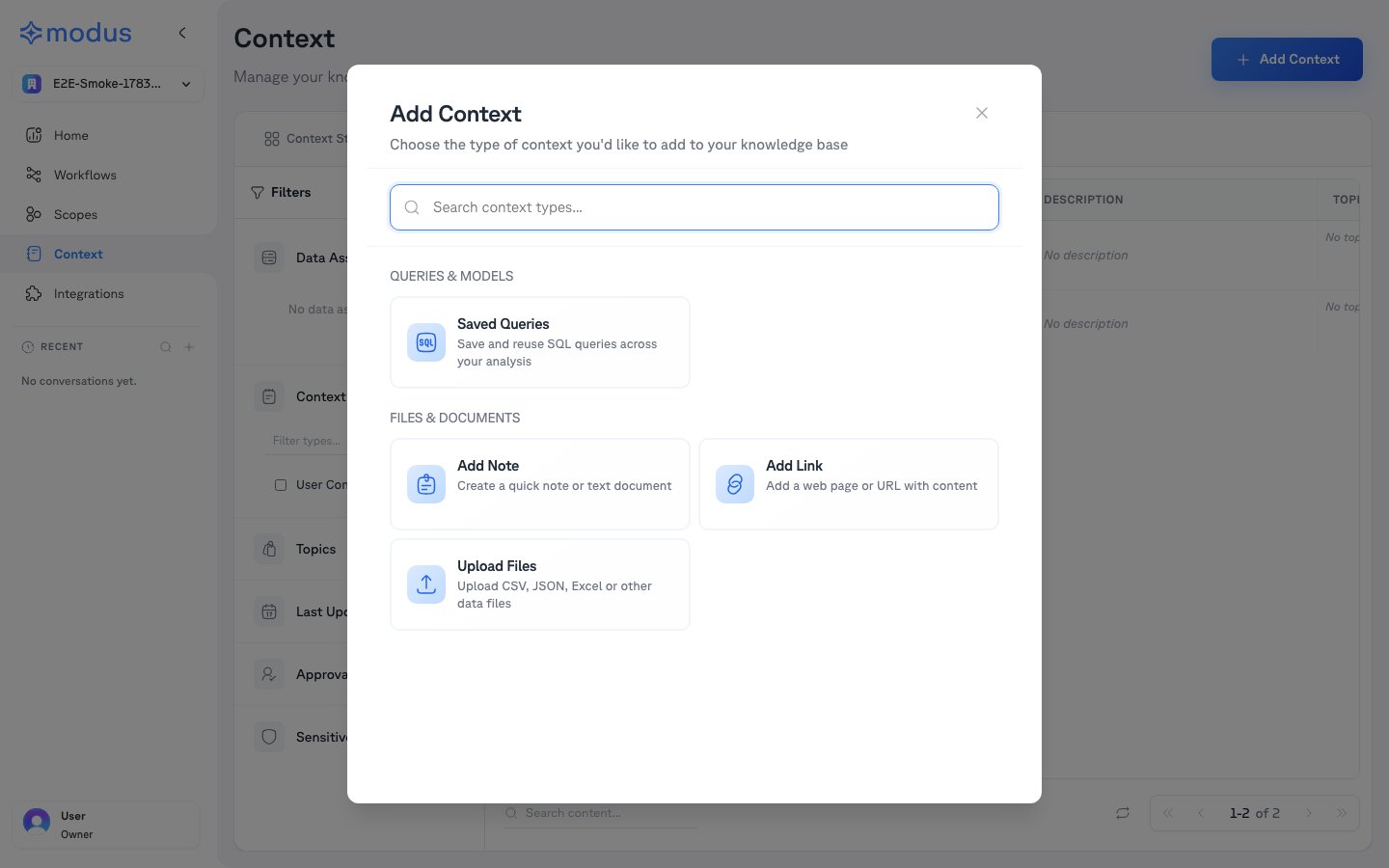 Save and reuse SQL queries across your analysis so scopes can build on proven logic.
Capture a definition, caveat, or piece of tribal knowledge as a quick text document.
Point Modus at a web page or URL whose content should inform answers.
Upload CSV, JSON, Excel, or other data files to bring in reference data.
## Browsing and filtering All Items
The **All Items** view is a filterable, paginated table of every context item —
its **type**, **content**, **description**, **topics**, **verification** status,
and **last update**.
Save and reuse SQL queries across your analysis so scopes can build on proven logic.
Capture a definition, caveat, or piece of tribal knowledge as a quick text document.
Point Modus at a web page or URL whose content should inform answers.
Upload CSV, JSON, Excel, or other data files to bring in reference data.
## Browsing and filtering All Items
The **All Items** view is a filterable, paginated table of every context item —
its **type**, **content**, **description**, **topics**, **verification** status,
and **last update**.
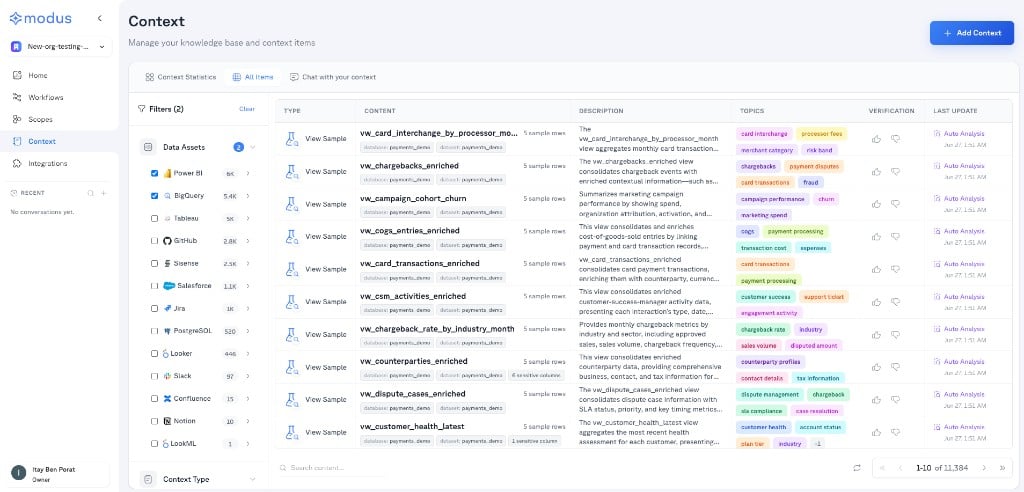 The filters sidebar narrows large knowledge bases quickly:
* **Data Assets** — drill into a specific connection, database, or schema.
* **Context Type** — filter by the kind of item (notes, saved queries, mined definitions, and more).
* **Topics** — items tagged with a business theme.
* **Last Updated** — by time window and by source (**AI Generated**, **Auto Analysis**, **Manual Edit**).
* **Approval Status** — **Approved**, **Unreviewed**, or **Rejected**.
* **Sensitive Data** — items containing detected sensitive information types.
Selecting an item opens a side panel with its full content, topics, update
history, and feedback — where you can edit or (for items you created) delete it.
## Verifying context
Context quality compounds. As you review items you can mark them **Approved**
(trusted), **Rejected** (wrong — Modus stops relying on them), or leave them
**Unreviewed**. Editing an item's content or description automatically marks it
approved. The **Verified** and **Pending** cards track your progress.
## Chat with your context
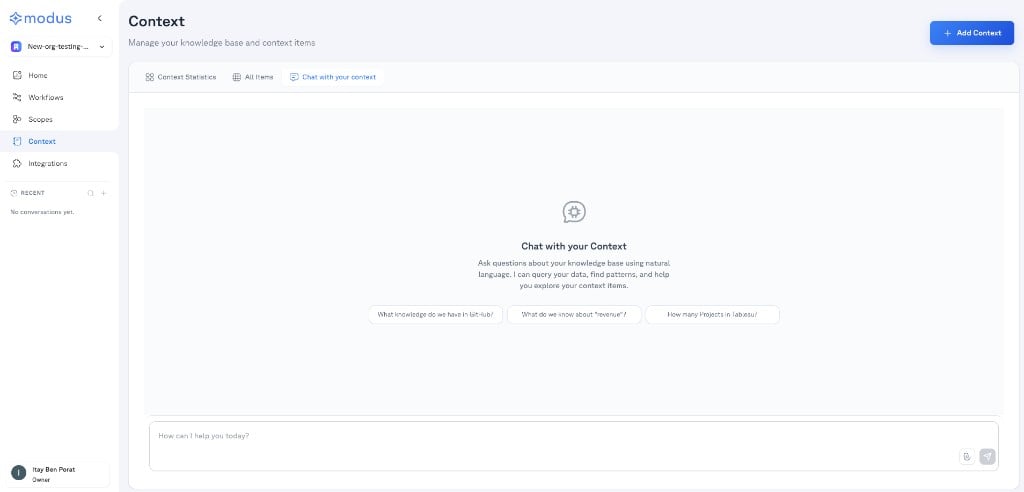
The **Chat with your context** view lets you talk to your knowledge base in plain
language — ask what Modus knows, find patterns, and explore items ("What do we
know about *revenue*?", "How many projects in Tableau?").
The filters sidebar narrows large knowledge bases quickly:
* **Data Assets** — drill into a specific connection, database, or schema.
* **Context Type** — filter by the kind of item (notes, saved queries, mined definitions, and more).
* **Topics** — items tagged with a business theme.
* **Last Updated** — by time window and by source (**AI Generated**, **Auto Analysis**, **Manual Edit**).
* **Approval Status** — **Approved**, **Unreviewed**, or **Rejected**.
* **Sensitive Data** — items containing detected sensitive information types.
Selecting an item opens a side panel with its full content, topics, update
history, and feedback — where you can edit or (for items you created) delete it.
## Verifying context
Context quality compounds. As you review items you can mark them **Approved**
(trusted), **Rejected** (wrong — Modus stops relying on them), or leave them
**Unreviewed**. Editing an item's content or description automatically marks it
approved. The **Verified** and **Pending** cards track your progress.
## Chat with your context
The **Chat with your context** view lets you talk to your knowledge base in plain
language — ask what Modus knows, find patterns, and explore items ("What do we
know about *revenue*?", "How many projects in Tableau?").
 It's also a fast way to **curate** your context. The agent can **edit context
items directly from the conversation** — for example, ask it to rewrite a vague
**description**, retag **topics**, or change an item's **verification** (approve
or reject) — so you can clean up and trust large knowledge bases without hunting
through the table by hand. This pairs well with the [scopes](/guides/scopes) that
read from context: better descriptions and verified items mean sharper answers.
## Putting context to work
* Each [scope](/guides/scopes) selects the **slice of context** it needs in its Context tab, so specialists stay focused.
* Answers on [Home](/guides/home) are grounded in this context, which is why verifying it improves every conversation.
The more of your context that's **Approved**, the more accurate and confident
your AI answers become. Verify the definitions your team relies on first.
It's also a fast way to **curate** your context. The agent can **edit context
items directly from the conversation** — for example, ask it to rewrite a vague
**description**, retag **topics**, or change an item's **verification** (approve
or reject) — so you can clean up and trust large knowledge bases without hunting
through the table by hand. This pairs well with the [scopes](/guides/scopes) that
read from context: better descriptions and verified items mean sharper answers.
## Putting context to work
* Each [scope](/guides/scopes) selects the **slice of context** it needs in its Context tab, so specialists stay focused.
* Answers on [Home](/guides/home) are grounded in this context, which is why verifying it improves every conversation.
The more of your context that's **Approved**, the more accurate and confident
your AI answers become. Verify the definitions your team relies on first.